
Floyd 24 Hour Release Gap
The Floyd County Sheriff’s Office site does not expose a verified list of everyone released during the prior day. Its reviewed links also did not identify a jail roster archive, feed retention rule, update cycle, or recent-release photo gallery. Those details are unknown, not zero. A current inmate list from another source cannot be repackaged as a Floyd County release log.
This distinction matters. A current roster answers who may still be confined. It does not state why a missing name disappeared. The person may have posted bond, completed time, entered home incarceration, moved to another jail, or transferred into Kentucky Department of Corrections custody. Affirmative evidence should show a date, status, authority, or agency confirmation.
Check Floyd Same-Day Releases
Begin with the last known facility. For Floyd County Detention Center, VINE can show the local booking record and a reported date released. The detention center is the best source for the physical release transaction. The Floyd Circuit Court Clerk can supply the bond order, judgment, sentence, or later order that gave legal authority for the change.
- Search Kentucky VINE for the local jail record by name or identification number.
- Match the person and reporting agency before reading the custody status.
- Contact Floyd County Detention Center and ask how to obtain the existing release transaction or custody history.
- Request the controlling order or disposition from the Floyd Circuit Court Clerk.
- If the person has a DOC number, check KOOL and the dated Kentucky DOC Daily Releases file.
Save the access date and exact record title. Dynamic custody data changes. For a named-person search that reaches beyond one day, the full Floyd County release path is on the home page.
Floyd 24 Hour Record Fields
Because no official county feed was found, Floyd has not published a standard set of 24-hour list columns. A focused request can seek the actual fields that confirm the transaction. Ask for existing records, not a new report or answers to a questionnaire.
| Requested field | What it can establish |
|---|---|
| Name and agency identifier | Which person and custody record the event concerns |
| Booking or admission identifier | The specific jail stay tied to the release |
| Effective date and time | When the agency recorded the physical custody change |
| Release type or authority | Bond, court order, time served, discharge, or another coded reason |
| Releasing facility | Whether the event came from Floyd jail, a state prison, or another agency |
| Destination or status | Community release, supervision, transfer, or another public status when releasable |
Kentucky DOC uses a different field model. Its Daily Releases files show DOC number, name, type of release, Released From, and highest felony class. They omit the county booking number, exact release time, and booking photo.
Floyd DOC Daily Releases
The Kentucky DOC Daily Releases archive is a strong released-first source for state-connected people. Dated PDFs can name Floyd County Detention Center in the “Released From” column. One official example records a DOC-coded minimum-expiration discharge from the Floyd jail. Another dated file uses “Administrative Minimum Expiration.”
That archive is not a rolling Floyd County feed. It covers DOC-linked people released from prisons or local jails, and publication may follow business-day patterns. A person released on an ordinary local bond may have no DOC number and no entry. Browse the suspected date, open the PDF, then match both the name and DOC number before relying on the release type.
In short, the archive survives after a live roster changes, but its scope is narrower than all Floyd jail exits.
News-Dated Floyd Release Proof
Local and regional reporting may preserve a notable release event after a live custody screen changes. The successful manifest image below comes from a LEX18 report documenting a Floyd jail bond release.
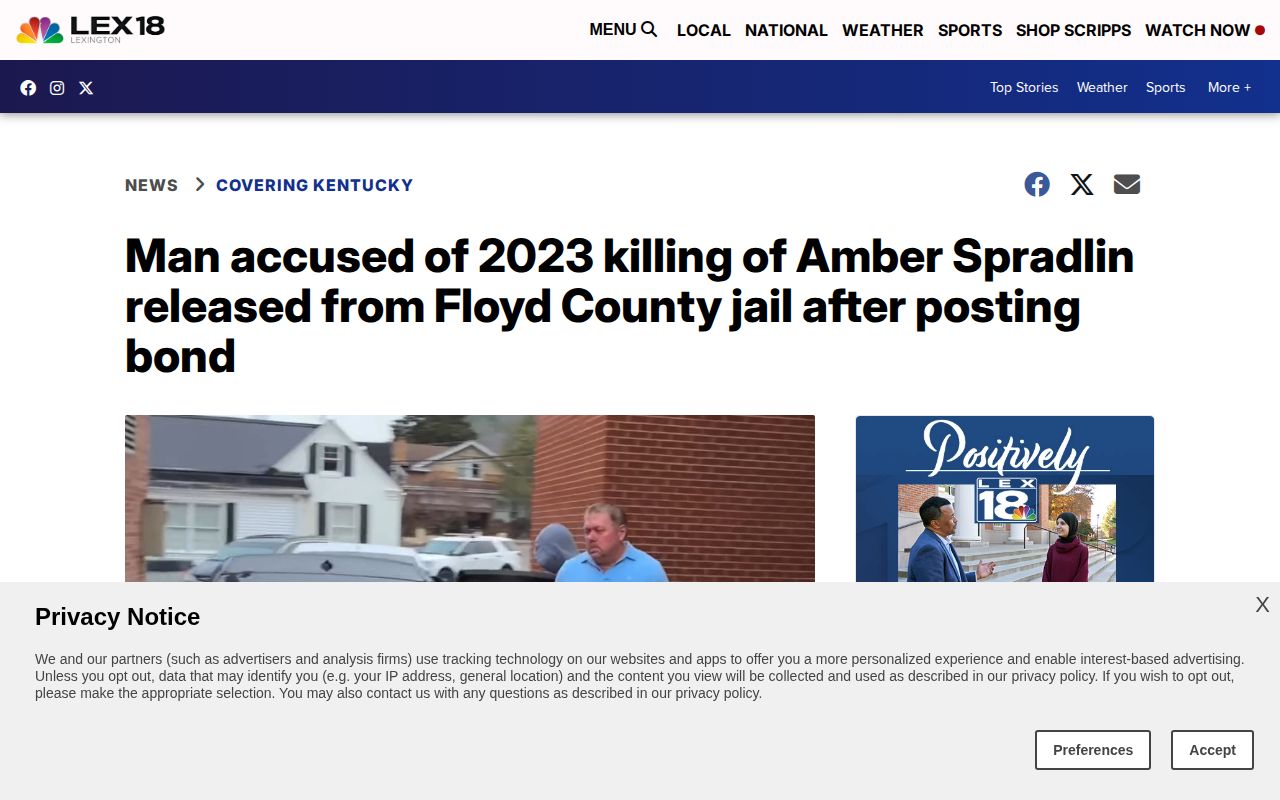
The report documents one event. It does not establish a general bond schedule, daily exit time, or county feed. Other dated reporting on the same matter noted home incarceration, GPS, and court conditions, showing why “released” may mean the jail stay ended while legal limits remained.
News is selective. Treat it as a dated lead and corroborate it with the jail transaction or court order.
Floyd Release App Not Verified
No sheriff mobile app, official booking-photo gallery, or recent-release photo page was identified through Floyd’s official site. An app-only 24-hour feed should not be assumed. The practical alternatives are a targeted booking-photo or release-record request, VINE for a named person, and KOOL when the person is tied to Kentucky DOC.
Photo absence also says little about release. KOOL may display a state offender photo, but it may differ from the Floyd booking image. A news image can be a file photo rather than the agency booking photograph. Keep each source and date attached to the image.
Note: Floyd County has not published the feed cadence, photo field, or retention window needed to support an official app claim.
Floyd Released Versus Transferred
A physical exit from Floyd County Detention Center is not always community release. Transfer to Southeast State Correctional Complex, another Kentucky prison, another county jail, federal custody, or immigration custody continues confinement under a different authority. VINE may label a transfer event, while KOOL can show a new institution or a Probation and Parole district.
| Record signal | Meaning |
|---|---|
| Released with date | The reporting source says that custody record ended |
| Transfer or new institution | Custody continued elsewhere |
| District 11 location | Community supervision, not final discharge |
| No roster result | Unknown without another confirming source |
Bond release ends physical jail custody under court terms, but it does not resolve the charge. Home incarceration also ends the jail stay while court limits continue. Parole places a state prisoner in the community before final sentence expiration. Mandatory reentry supervision is another supervised status and should not be mislabeled as a parole grant. “Discharged” is stronger language, yet another case or sovereign may still affect the person.
For a wider window that can bridge more dated files, use the Released Last 72 Hours page. Agreement among the agency release status, legal order, and custody or supervision transition gives stronger confirmation than any one missing roster name.
Request Floyd Same-Day Records
Kentucky’s Open Records Act appears in KRS 61.870 through 61.884. A Floyd request should identify the person, give an approximate booking and release range, and name the existing records sought. Useful items include the booking sheet, custody-status history, effective release date and time, release type, authority, releasing facility, and releasable transfer destination. Ask the custodian to redact exempt material and provide the rest.
Do not ask officials to create a new 24-hour list. The reviewed sheriff site does not publish a special jail form, email address, fee schedule, or guaranteed delivery method. Call first to confirm the correct custodian and submission channel. Kentucky law generally calls for an agency response within five business days after receipt, subject to lawful extensions and explanations, but that response period is not a promise of same-day production.
Medical, juvenile, protected victim, sealed, expunged, and security-sensitive records may be withheld. A narrow request for the release transaction is more useful than asking for every file connected to the person.
The Floyd court record can add context without replacing the jail record. A bond or release order explains legal authority. A later disposition can show dismissal, conviction, probation, or another result. Yet the order may not show when the person walked out. Pair it with the jail custody log, VINE event, or DOC entry when one applies.
If an old case is not at the counter, ask the clerk where the file is held. Kentucky’s records center needs the case and file locator supplied by the clerk and cannot search on a name alone. A sealed or expunged matter may not appear through normal public access, so a missing result proves little.