
Floyd County Projected vs Actual Release
A projected release date is a calculation based on the sentence and information held at that time. An actual release date records a completed custody event. Kentucky DOC projections can reflect prior-custody credit, statutory credits, sentence structure, forfeitures, restorations, and legal limits. They are not the same as a parole eligibility date, hearing date, minimum expiration, maximum expiration, or final discharge.
Custody type changes the answer. A pretrial detainee at Floyd County Detention Center has no DOC sentence date to calculate. Release may turn on bond, a dismissal, a court order, home incarceration, or another lawful action. A sentenced person at Southeast State Correctional Complex is on the state path. A transfer between facilities is continued custody, not release.
Find a Floyd County Projected Date
Kentucky Offender Online Lookup, known as KOOL, includes Projected Release Date From and Projected Release Date To filters. Those filters find DOC-linked records, not every person booked at the Floyd jail. Start with minimal criteria and identify the record by DOC or PID number when possible.
- Name the custody system. Separate Floyd jail custody from Southeast State Correctional Complex or another Kentucky prison.
- Search KOOL for a state record. Use the exact name or identifier, then open the detail.
- Read all related fields. Compare current location, status, sentence data, supervision, and projected release date.
- For county custody, contact the jail and clerk. Ask for the release calculation, judgment, sentence, bond order, and later custody orders.
- Check the legal event. Compare parole material, detainers, amended judgments, and applicable sentence-credit rules.
- Confirm after release. Use VINE, DOC Daily Releases, or the jail release transaction rather than the old projection.
The Floyd County release search path helps when the person has already left custody. A missing KOOL record can mean the person never entered DOC jurisdiction, and a county jail shown in KOOL covers only the DOC-linked subset.
KOOL’s advanced form also includes name, DOC number, PID number, supervision status, location, county of supervision, crime name, KRS code, conviction date, supervision begin date, abscond dates, and other filters. Use only enough fields to find a manageable set. Too many criteria can hide the record when one date or spelling is wrong.
Open the detail and note status before copying a date. A prison or jail points to custody. A Probation and Parole district generally points to community supervision, which is release from confinement but not final discharge. An absconded notation requires separate verification.
Kentucky Credits and Floyd Release Dates
KRS 197.045 provides Kentucky’s main sentence-credit framework. It addresses prior confinement and credits tied to approved education, programs, good behavior, and meritorious service, with limits that depend on the record. KRS 532.120 is also relevant to time spent in custody before sentencing. No single arithmetic rule fits every Floyd County case.
Concurrent or consecutive sentences, offense date, offense class, later judgments, revoked supervision, and discipline can alter the calculation. Credits may be earned, forfeited, restored, or restricted. A court’s sentence is the base legal record, while DOC’s sentence-computation record shows how the agency applied the law to that person.
County release calculations are different. A bond release is controlled by the court, not DOC earned time. No Floyd-specific public county good-time policy was verified. Request the jail’s written calculation or the court record instead of importing a rule from another county.
The computation can involve several judgments. Concurrent terms run together as the orders provide, while consecutive terms can extend the aggregate. A later revocation may change credit. These are person-specific questions, and a portal summary may omit the detail needed to reproduce DOC’s result.
For a formal explanation, request the existing sentence-computation record from Kentucky DOC. Include the full name and date of birth or DOC identifier. Written offender-record requests remain subject to correctional, privacy, and security limits.
Why Floyd County Release Dates Change
A projection can move in either direction. The cause should be documented rather than guessed. KOOL is updated as DOC information changes, and the agency warns that newer information may not yet be final.
| Factor | Possible effect | Record to check |
|---|---|---|
| Prior-custody credit | Changes credited time | Judgment and sentence computation |
| Earned credit or forfeiture | Moves the current calculation | DOC computation and disciplinary record |
| Amended court order | Changes sentence terms or credit | Floyd clerk case file |
| Parole action | May begin release planning or defer release | Board action sheet and KOOL |
| Detainer or warrant | May cause a handoff or continued custody | Holding agency and court record |
| New sentence or revocation | Can add or recompute time | Court order and DOC master file |
Parole eligibility is not a promise of parole. A Board grant also does not establish the physical exit time. Release planning and another agency’s hold can intervene after the decision.
A detainer is a notice from another authority that may cause a handoff when the current term ends. A person can leave Kentucky DOC custody and enter another agency’s custody without entering the community. Read the release source and destination together when available.
A wrong credit entry, amended judgment, or delayed document can also revise KOOL. Save the earlier screen with its access date, then rely on the corrected agency record rather than treating the first projection as a promise.
Confirm a Floyd County Release
For a state prisoner, capture the KOOL detail and access date. Compare it with the judgment, DOC Daily Releases, and any Parole Board action. Daily Releases can show DOC number, name, coded release type, Released From, and highest felony class. A file naming Floyd County Detention Center covers DOC-linked releases from that facility, not every local bond release.
For a jail detainee, the Floyd clerk’s order explains legal authority. The jail transaction is better evidence of the actual exit time. Kentucky VINE can show a date released when the local booking record reports one. The Floyd County VINELink release check can also register a status alert.
The Floyd Circuit Court Clerk is the starting point for District, Circuit, and Family trial files. Ask for the docket, judgment, sentence, bond or release order, and later modification or revocation orders. For an old file, the clerk must supply the locator because the records center cannot search by name alone.
VINE may hold separate local-jail and DOC records for one person. Read the reporting agency. A transfer means custody continues, while a released result supplies the date reported for that specific record.
Note: Save the exact source and access date because dynamic custody fields can change after a new order, transfer, or correction.
Floyd Release Dates and 85 Percent
KRS 439.3401 is the key current rule for a statutory violent offender. Under the version effective July 15, 2026, a covered person serving a term of years generally must serve at least 85 percent before probation, shock probation, parole, conditional discharge, or another early release described by the law. The statute also limits which credits apply to that minimum.
“Violent offender” is a defined legal category. It does not mean every felony involving conduct that sounds violent. The covered list and special sentence rules are detailed, so use the current text and the actual conviction record. Older regulations or cached summaries may show older language, including an “85 percent or 20 years” formulation. The enacted statute controls.
This rule should not be used to calculate a person’s date without the full record. Offense date, sentence type, statutory classification, and prior-custody credit all matter.
The statute contains detailed offense categories and sentence rules. A short portal label may not reveal every element needed for classification. Use the conviction judgment and current statutory text. If an older agency summary conflicts, ask DOC for the computation.
Federal Release Dates in Floyd County
A federal record does not belong in KOOL. The BOP Inmate Locator can show a future projected date or a past release date. “Released” and “Not in BOP Custody” refer only to BOP custody. Another sovereign or a period of supervision may still apply.
The BOP explains its released-record terms on its About Our Records page.
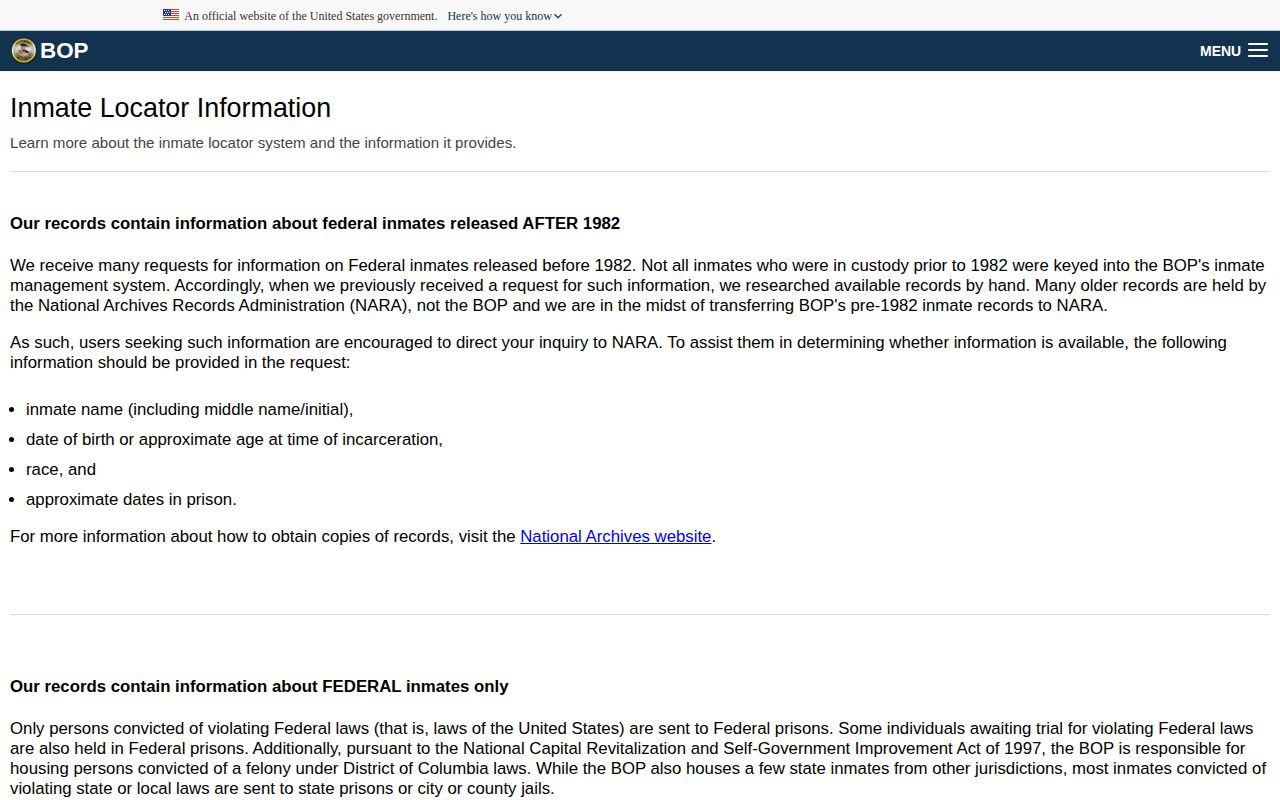
The guidance helps separate a federal custody result from a Kentucky jail or state-prison release record.
BOP also publishes an official sentence computation explanation.
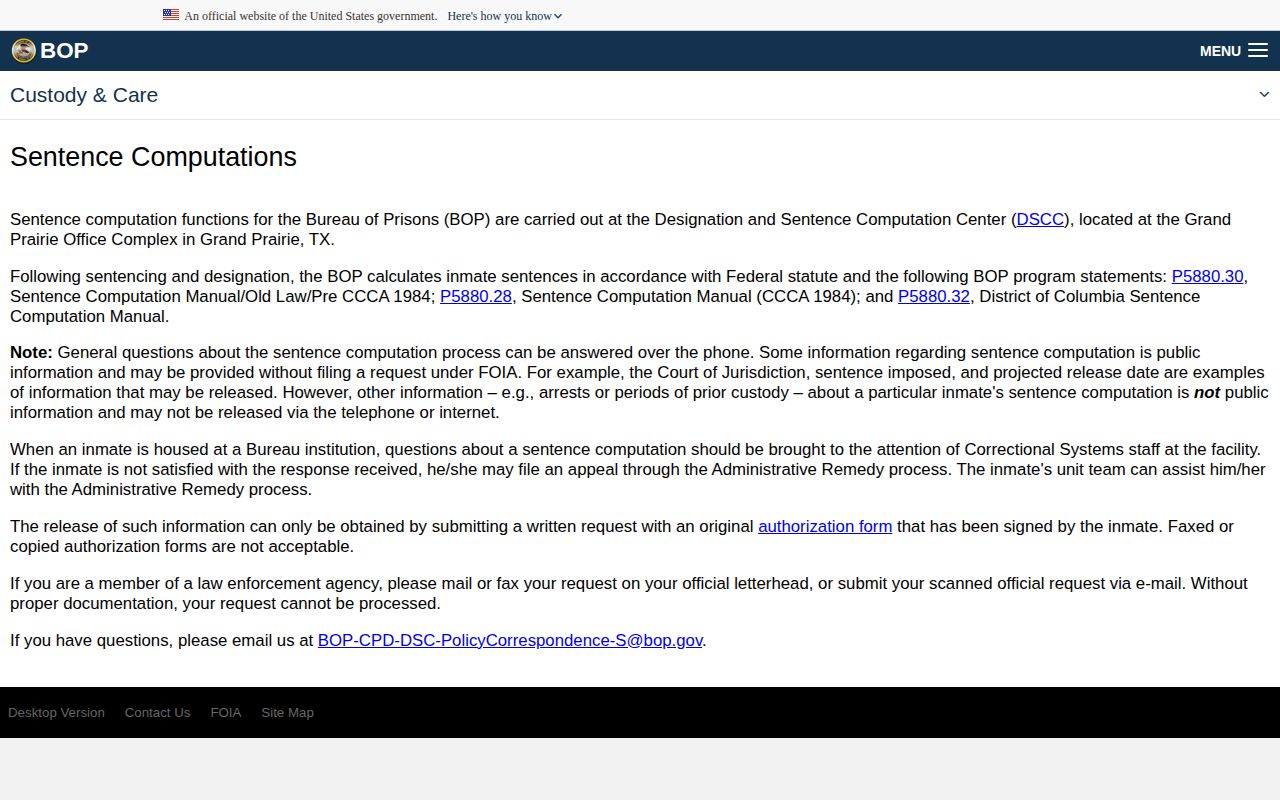
Federal computation rules are a separate system and should never be substituted for a Floyd County or Kentucky DOC calculation.
A BOP result marked UNKNOWN can reflect an undetermined term, including some pretrial or unsentenced settings. IN TRANSIT can involve movement through the U.S. Marshals Service and may lag a court event. For a federal pretrial person, use the federal court release or detention order because USMS has no public person locator like BOP.
The same separation applies to immigration custody. An ICE release can include check-ins or another alternative to detention, and the locator has a limited released-record window. Neither a federal nor immigration result changes the meaning of a Kentucky DOC projection.
A negative result also has limited value. No KOOL match may mean the person never entered Kentucky DOC jurisdiction, while no BOP match may reflect a different form of federal custody or an older record. No court result can stem from the wrong county, access limits, sealing, expungement, or retention. Strong confirmation comes from agreement among the sentence record, agency status, and the completed custody event.
If the sources conflict, keep screenshots and document titles with the access date. Ask the agency that owns the disputed field to explain or produce the existing computation. Do not merge a projected state date, a federal result, and a county court event into one timeline unless the identifiers and custody transitions match.